
Your Team Is Working Hard. But Is Everyone Working From the Same Page?

Updated: Jul 20
*Affiliate Disclosure: Some links on this page are affiliate links, which means I may earn a commission if you purchase through them, at no additional cost to you. I only recommend tools I personally use or have thoroughly vetted and confidently stand behind to help service business owners build structured, profitable companies.

Jobber is currently offering 40% off the first 3 months for new customers, and the offer ends June 30, 2026.
For many service businesses, this is the moment where things start to tighten up heading into busier seasons. If your team is growing or your schedule is getting harder to track, this is a good time to put a system in place before things get more complicated.
Start with the free trial and choose the plan that fits your team once you see how Jobber works inside your business.
There was a point in our business where everything looked busy on the surface.
Calls were coming in. Jobs were getting scheduled. Technicians were out in the field working hard all day.
But behind the scenes, things were starting to slip.
A customer would call asking for an update and the office would have to track down the answer. A job detail would change, but not everyone would see it right away. Someone in the field would have one version of the job, while the office was working off another.
Nothing felt completely broken, but nothing felt fully connected either.
And that is where the problem really starts.
When your team is working hard, but not working from the same information, the day becomes heavier than it needs to be.
Why It Starts Small but Grows Fast
At first, it does not look like a system problem.
It looks like a communication issue. A missed detail. A quick phone call to clarify something.
But over time, those small gaps start stacking up.
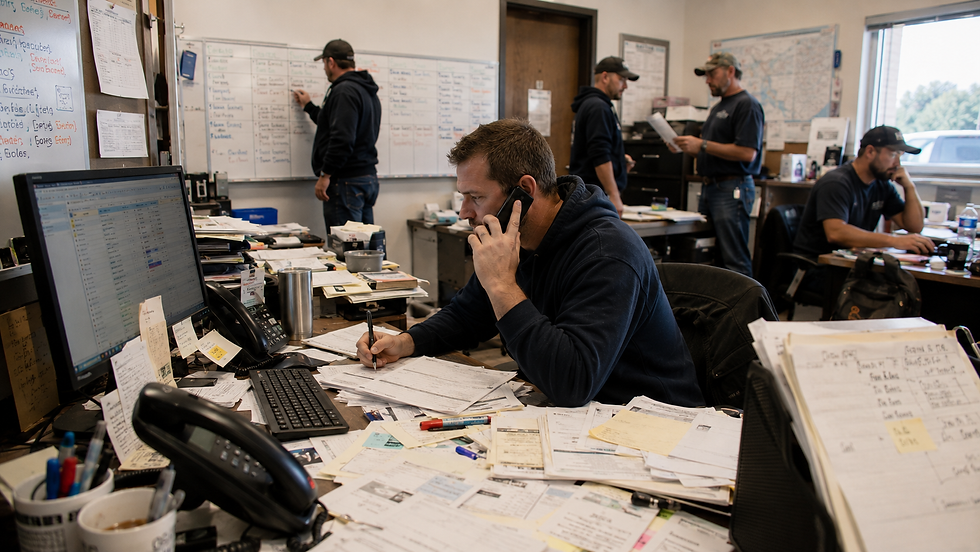
Schedules change and not everyone sees it right away. Job notes get updated, but only in one place. Customers are waiting on answers while the office is trying to piece together what is actually happening in the field.
The work is getting done, but the coordination behind it is getting harder every day.
And most owners do not notice it until they are the ones constantly stepping in to fix it.
The Breaking Point
The breaking point usually does not come from one big failure.
It comes from exhaustion.
The constant checking. The follow-ups. The “did you see this update?” messages. The feeling that even though everyone is working, you still need to keep everything moving manually.
That was the moment it became clear something had to change.
Not because the team was not working hard.
But because everyone was working hard in different directions.
That is when we realized the real issue was not effort.
It was visibility.
The Shift
Once we stepped back and looked at the way information was moving through the business, the problem became obvious.
The office had one view of the day. The field had another. And the owner was stuck trying to connect the two.
That is when we moved toward a system that gave everyone the same source of truth.
Job details, notes, and updates all in one place. Not scattered across texts, calls, and paper notes. Everyone could see what changed, when it changed, and what still needed to be done.
That shift changed how the entire day felt.
What Changed With Structure
With a shared system in place, communication stopped being something we had to chase.
When a job was added or updated, the right people were notified immediately. The office did not have to manually track down updates. The field did not have to wait for a call to confirm details.
Technicians could see job details, notes, and photos right from their mobile app. That alone removed a lot of confusion during the day.
And instead of constant check-ins, we could actually see progress in real time.
The work did not change.
But the way it moved through the business did.

The Outcome
What changed most was not speed.
It was clarity.
We were no longer guessing where things stood or relying on memory to keep the day moving. Everyone had access to the same information, and that reduced a lot of unnecessary stress across the board.
The team still worked hard. That never changed.
But now the work had structure behind it.
If you want to build a more organized and profitable plumbing business, start by improving how your plumbing quotes, scheduling, and customer communication are handled every day.
The operational systems I implemented inside Pete’s Plumbing completely changed how our business functioned as we grew.
*Affiliate Disclosure: Some links on this page are affiliate links, which means I may earn a commission if you purchase through them, at no additional cost to you. I only recommend tools I personally use or have thoroughly vetted and confidently stand behind to help service business owners build structured, profitable companies.

Sandra Wallmann
35+ Year Service Business Owner | Founder of Sandra’s Business Guide
Sandra Wallmann has spent over 35 years running Pete’s Plumbing & Heating, building systems that support consistent revenue, strong client retention, and long-term growth. She is also the owner of Hit the Spot Treats, a corporate gifting business focused on client appreciation and retention.
Through Sandra’s Business Guide, she shares real-world strategies to help service business owners move from daily operations into true ownership.


Comments